By Ryan Elmore
In the play Thom Pain (based on nothing) written by Will Eno, the titular character poses a rhetorical question to the audience. He asks them what they would do if they found out they had only a short time left to live. He offers some suggestions — perhaps they’d reconnect with that one family member, maybe take that trip they’ve always thought about, laugh more, live more honestly — the point being that we’d live more uninhibitedly with that reminder of life’s preciousness. Then Thom takes a moment, pauses, and then asks, “What would you do if you had 40 years?”
That play, which earned Eno a nomination for the Pulitzer Prize in 2005, can ostensibly function as the mission statement by which he has driven his playwriting career. In that little example, you can see most of Eno’s preoccupations: a metaphysical consciousness, undisguised questions posed directly to an audience, observations that are simultaneously elusive and on the nose, and, of course, a dry and darkly comedic wit. It was all of these things that endeared him to me as a writer and are the main reasons why I wanted to direct Albright College’s upcoming production of Middletown, also by Eno.
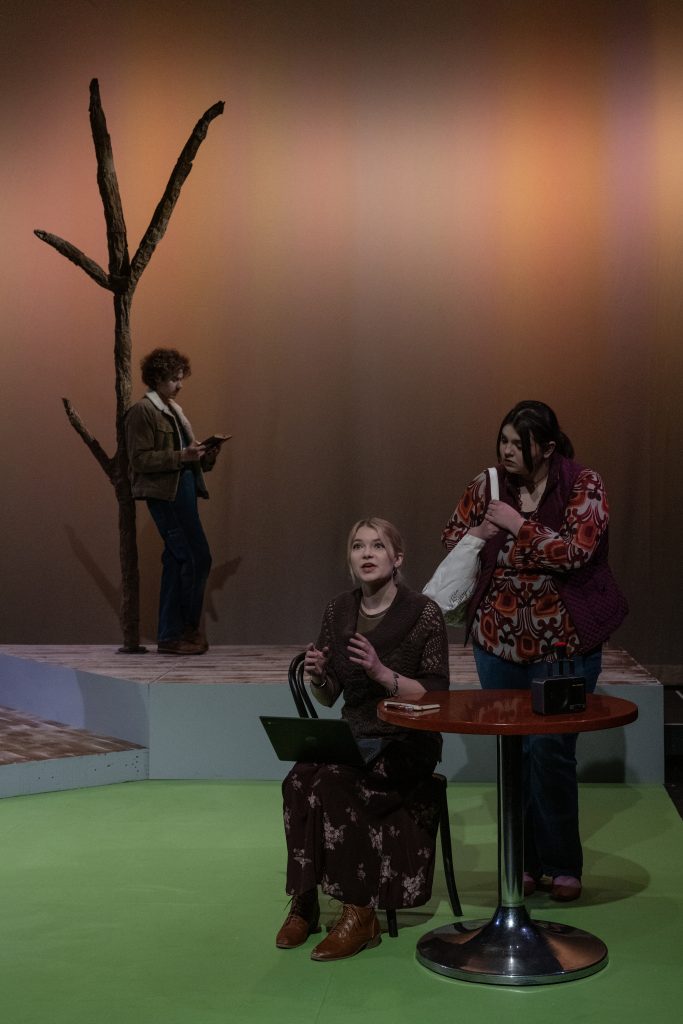
The show, which opens on Feb. 12, has been semi-atypical in its production. Typically, within Albright’s theatre department, students are educated by example, meaning that the creative team working on the project is made up of faculty leaders with years of experience within their given field. The director, light and sound designers, costumers, and scenic designers are experienced professors or professionals who have students learning the field by working under them. This time, students have taken the helm from directing all the way to props design. In other words, the department is allowing the students to learn the hard way.
Luckily, unluckily, the hard way is the only way I’ve ever learned anything. After we assembled a full creative team, we went back to the play to work out the what and the how of bringing it to life. Middletown, to give an impression, is a 2010 play which follows a woman named Mary Swanson as she moves to a generic American suburb called Middletown and begins a friendship with a longtime resident named John Dodge. The pair grows closer as a result of their shared loneliness. In the meantime, we see vignette-ish scenes in which tertiary characters take the stage to offer blasé, boneheaded, and sometimes poignant remarks about their lives in the small town. Also present are meta-theatrical scenes that actively comment on the play as it’s performed (one example includes the play’s “intermission” in which actors take the role of audience members and speculate as to what’s to come in Act 2).

For some, this might sound awfully similar to another American play with town in the title. In many ways, Eno’s Middletown is attempting to follow in the same tradition of Thornton Wilder’s 1938 Our Town, a play which also includes a small town, ruminations on life, and meta-theatrical elements. Thornton Wilder’s Our Town is one of the most important plays to populate the American theatre canon, and Wilder himself might be depicted alongside other writers on the Mount Rushmore of 20th-century American playwrights.
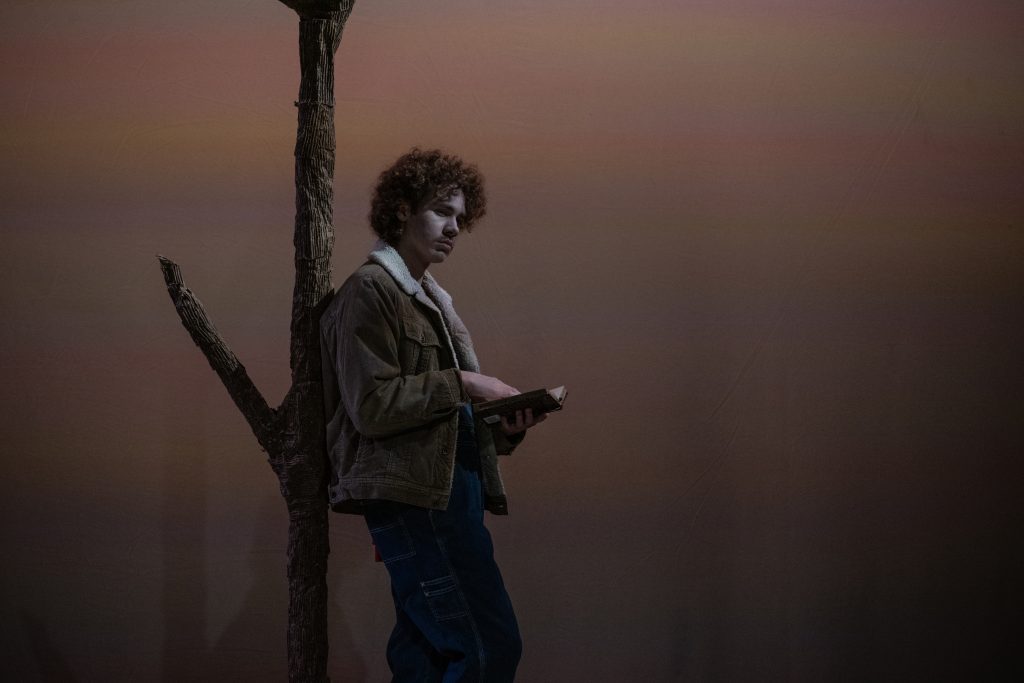
Both plays offer a meditative and self-inspecting theatrical experience. The characters of Middletown are no strangers to breaking into rumination about themselves and their environment, whether it be on a micro or macro scale. The play is a forum for varied ideas and viewpoints. With that in mind, the set we constructed is a communal one, reminiscent of a town square, a public park, or a courtyard. The action of the play will simultaneously take place in the various settings of the play — a library, a hospital, a townhouse — and within this community space. With the help of our scenic designer, Murphy McCabe, and our props designer, Marisa Sblendorio, our set’s various fixtures have multi-purpose functionality. A community library exists both as the shelves of the town’s public library and the filing cabinet in a doctor’s office. A tree sits at the center point just upstage and functions as a town monument, a satellite, and an expressive indicator of continuity. Our costume designer, Lauren “Lou” Ressler, has been inspired by small-town Americana in the 21st century to create looks that feel familiar and recognizable.

We had six weeks to rehearse the show before performances. As a first-time director, I heard the phrase “never a dull moment” from mentors and advisers practically once a day. The painful thing is it’s absolutely true. You want a reminder of how precious and special time is? Direct a play. Lesson number one of directing is figuring out that half the job is mitigating problems for your future self. Some problems, of course, arise involuntarily. The week before rehearsals started, in an instance of spectacularly poor timing, I tripped over a curb and ended up breaking my right ankle in two places, leaving me stranded at home while I awaited surgery and began the first couple of steps (no pun intended) of recovery. Lesson number two — surround yourself with capable and talented people. While I was out, my stage manager and friend, Angel Alvarado, directed the early blocking rehearsals based on scribbly notes I’d given him. He used these and his own keen eye to make sure we didn’t fall behind, as I wasn’t able to get into the room until the second week of rehearsals. The cast, in turn, was prepared, diligent, and passionate about the work they were doing. When I eventually arrived, I was shocked by how much had gotten done and how much the play had transformed beyond my imagination.
The rest of the process was not as dramatic as the first couple of weeks, albeit the occasional need to put out small fires here and there. Our set, which had long existed as tiny models and sketches, eventually was completed — likewise with props, lights, and costumes. The rehearsal process is a funny thing. There’s a moment before where the entire thing seems infinite and insurmountable. Then there’s a moment at the end where you look around and see that things have more or less shaped up. In the middle is a great haze. Lesson number three — breathe.

Middletown opens at the Albright College Theatre on Thursday, Feb. 12, at 7:30 p.m. Performances run Thursday, Friday, and Saturday at 7:30 p.m. and Sunday, Feb. 15, at 2 p.m.