Students worked with the Snoqualmie Indian Tribe on conservation efforts in the region.
From Penn State Berks
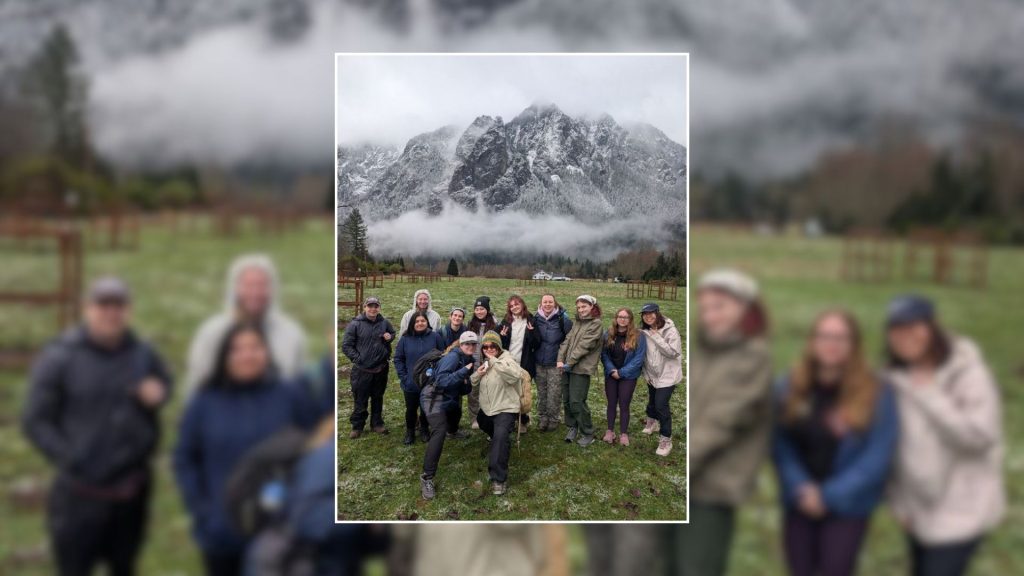
Pictured above: Penn State Berks students and staff advisers traveled to the Seattle area for Alternative Spring Break. From left to right: Evan Imschweiler, Heather Hoffman (back), Cassandra Barbounis, Emily Shugar, Arianna Cruz (staff), Paria Khalili, Jada Savage, Lilith McHugh, Kaelyn Balbirer, Shuai Shao (staff), (front row) Madison Armstrong, and Litzuli Hernandez-Sanchez. Photo courtesy of Give Guide Carly Jo
While many students enjoy their spring breaks with their families and friends or travel to a vacation destination, 10 Penn State Berks students, joined by students from Penn State Harrisburg and Penn State Scranton, decided instead to travel to the Seattle area, where they worked with members of the Snoqualmie Indian Tribe on conservation efforts and with Sound Salmon Solutions on efforts to help restore and protect waterways. The effort was part of the Alternative Spring Break program, where students serve and learn about other communities — and themselves — through hands-on service.
The experience was coordinated by GIVE Volunteers, a nonprofit organization whose mission is “to inspire growth, empower global citizens and ignite sustainable change worldwide.”
Madison Armstrong said, “I really liked working with GIVE because I feel like they’re very transparent about what they do. Every curveball, they handled.”
The trip consisted of two parts: service and learning. The first part, service, centered around working with members of the Snoqualmie Indian Tribe on conservation and sustainability initiatives and with Sound Salmon Solutions to help restore and protect waterways. The second part, education, focused on the history of the tribe and tribal culture.
The Snoqualmie Indian Tribe, whose headquarters are located in Snoqualmie, WA, is a sovereign tribal nation with its own constitution and laws governing its citizens. Working together, the group spent their days working with the Snoqualmie Tribe’s Environmental and Natural Resources Department, supporting the tribe’s commitment to habitat health and cultural stewardship, and working to remove invasive plants such as blackberries and plant native trees along local riverbanks. All the while, students learned about personal responsibility when interacting with nature and about sustainability.
Jada Savage commented that one of her favorite memories was being completely covered in mud, digging up blackberries in the rain. “We are completely covered in mud, digging the holes. We were out there digging up blackberries in the rain; it started hailing at one point. ‘Bruce the Spruce’ was the first tree I planted. I’d love to go back and see how Bruce is doing.”
Emily Shugar stated that she enjoyed the teamwork and positivity, stating, “When one of us would remove an invasive root, we’d hold it up in the air, and all cheer for each other.”
Evan Imschweiler added, “It was cool seeing how much different it is there. Our trees lose their leaves, and we have some evergreen trees, but they have so many more. It was interesting seeing those differences.”
Students also worked with Sound Salmon Solutions on restoring waterways for salmon habitats. The organization is part of the Regional Fisheries Enhancement Groups (RFEGs), chartered by the state of Washington to promote, support, and realize salmon recovery programs and projects in watersheds. Students planted trees as part of a long-term effort; as the trees grow taller, they will shade the waterways, providing the cooler water salmon need to thrive.
They also collaborated with Seattle’s Youth Garden Works, an organization helping young people gain leadership skills through farming, mentoring, and other programs, to plant seeds in a community garden that provides free produce to its low-income neighborhoods.
The students stayed positive through the changes in the weather. Heather Hoffman stated, “Everyone had a great attitude, and it made it easier to stay motivated.”
When they weren’t working, students had an opportunity to visit museums. At one, they joined an interactive activity where they weaved baskets and made mats from corn stalks while learning about the Snoqualmie tribal culture and their struggle to fight for their land and tribal recognition.
It wasn’t all work and no play. They took nature hikes in areas such as Rattlesnake Ledge, a trail that includes a view of the Cascade foothills, giving the students a sense of the impact of their work. After the hike, the group discussed how the trails are made and talked about the indigenous people who lived on the land, who did such hikes without trails. They also hiked to the Snoqualmie waterfall.
While the group didn’t actually stay in Seattle for the experience, students had an opportunity to visit Seattle, where they had an opportunity to take a break and interact with community members at a local coffee shop, visit one of the famous fish markets, and shop. With a newfound appreciation for the area, students made an effort to buy from local artists.
They ended every day by sharing ‘good vibes,’ a positive reflection on the day’s efforts and events.
Penn State Berks students who participated in the experience had to go through an interview process. They included Madison Armstrong, Kaelyn Balbirer, Cassandra Barbounis, Litzuli Hernandez-Sanchez, Paria Khalili, Heather Hoffman, Evan Imschweiler, Lilith McHugh, Jada Savage, and Emily Shugar.
They were accompanied by two staff members from Penn State Berks: Shuai Shao, associate director of student affairs, and Arianna Cruz, residence life coordinator, who helped lead the entire experience for the students. In total, five staff leaders accompanied 40 students. The participants commented that they were happy to build connections with the Snoqualmie Indian Tribe and with students from other Penn State campuses.
Cruz explained that the students stayed in a camp during the trip. “The majority of the week, we were working alongside the Snoqualmie River. Our camp was located in Carnation, WA, about an hour away from Seattle. We stayed at the camp instead of a hotel to focus on giving back to smaller businesses and limit waste that is created by single-use items/materials used at hotels.”
She added, “This was a really great opportunity for Shuai and I to get to work with our students in a different capacity that we typically aren’t able to see them in. For many of them, this experience was relative to their majors and goals, and it was an invigorating and eye-opening experience for us all as we hope to bring back these lessons to the East Coast.”
About Alternative Spring Break
The Penn State Alternative Breaks program provides opportunities for students to learn more about themselves, others, and the world around them through service. The program offers service trips throughout the academic year, including service weekends, fall alternative breaks, alternative winter breaks, and alternative spring breaks. Each program is designed to encourage personal growth and reflection, promote civic engagement around a social issue, and immerse participants in a new community.
You Might Also Like

Community Foundation Opens Universal Scholarship Applications for High School Seniors, Graduates

The Alvernia Campus Show – Season 2 Episode 2

Earth Day & Arbor Day | Are You Ready?