A student researcher and leader makes a strong impact on campus.
From Penn State Berks
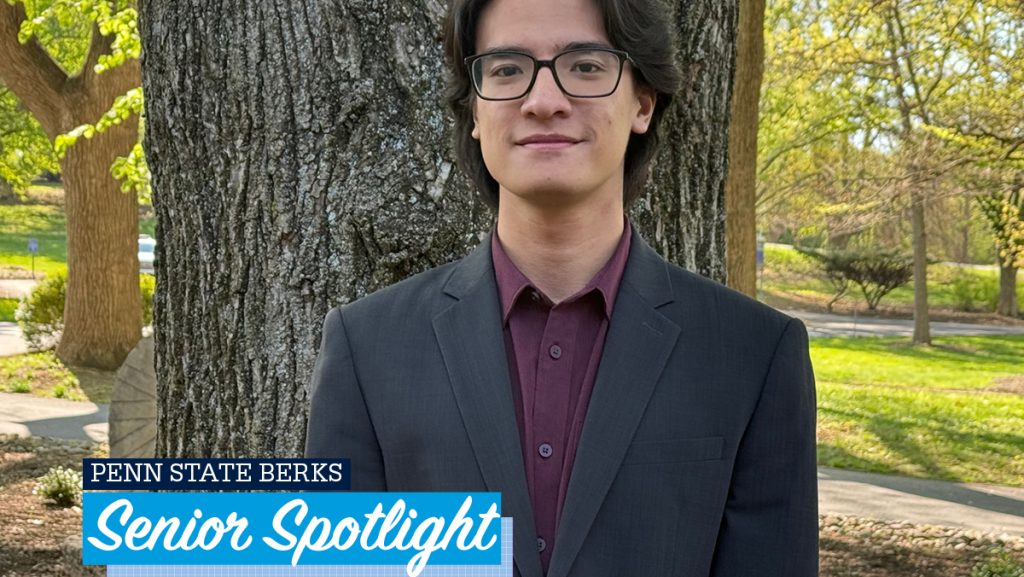
When Nathan Tam graduates on Saturday, May 9, he will have earned both a bachelor’s degree in biochemistry and molecular biology from Penn State Berks and a master’s degree in applied statistics from Penn State World Campus. The master’s degree is an integrative undergraduate graduate (IUG) degree program, which allowed him to complete the coursework for both degrees concurrently. He is also completing minors in both mathematics and chemistry.
Tam, of Reading, PA, was home-schooled, and he entered Penn State Berks with both advanced placement and dual enrollment credits.
He stated that he chose Penn State Berks because he wanted a Penn State degree close to home. Tam added, “My original plan was to complete my first two years at Berks, but I found that I had a lot of opportunities on campus and loved the community, so I stayed for all four.”
With a 4.0 GPA, Tam excelled as a student, and he was always willing to help his fellow classmates. He worked as a learning assistant for several math courses, and he was a tutor in the college’s Learning Center, helping students with upper-level math and chemistry.
The role of research
Research was a major part of Tam’s experience at Penn State Berks. As a first-year student, he began conducting research on computational chemistry with Chemistry Professor Lorena Tribe. Their research resulted in a study titled “Computational modeling of cysteine and glutathione.” Cysteine is an amino acid crucial for protein synthesis, detoxification, and antioxidant production, while glutathione is a potent, naturally occurring antioxidant in the body. Tam presented this research at two American Chemical Society national meetings in 2023.
Tam explained that he has always loved math, and computational chemistry combines math, coding, and chemistry.
He also worked with Tribe to conduct research on developing a program to incorporate computational chemistry into chemistry classes and expose undergraduates to research opportunities. This program, titled CATLION, a play on the chemistry term “cation” and the Nittany Lion, has been deployed in several chemistry courses at Penn State Berks. In building CATLION, Tam discovered a way to represent a common acid-base chemistry problem as a series of mathematical equations that could be turned into a web-based tool via Python code. This work led Tam to a first-author peer-reviewed publication titled “Understanding chemical equilibria: A Python tool for modeling protonation state relative concentrations,” published by the American Chemical Society.
More recently, Tam and Tribe studied the decarboxylation reaction: A chemical reaction that results in the release of carbon dioxide. They studied decarboxylation at the theoretical level, working with Penn State Institute for Computation and Data Sciences (ICDS) supercomputers. This research started when Tam received funding from the Penn State Erickson Discovery Grant in 2024, and it reached a pinnacle as his senior honors thesis for the Schreyer Honors College titled “Multivariate analysis of natural bond order descriptors in the decarboxylation of benzoate derivatives,” which applies statistical analysis to quantum-level calculations on molecules undergoing decarboxylation. This research has applications to biochemistry, chemical engineering, and environmental science.
Tam’s research extended beyond chemistry: He also conducted research in mathematics, which he presented at the Mathematical Association of America’s Eastern Pennsylvania and Delaware (EPaDel) Section Fall 2025 Meeting.
In addition, Tam was part of a three-student team from Berks that, competing against upper-level math students from elite universities, won the SIMIODE (Systemic Initiative for Modeling Investigations and Opportunities with Differential Equations) Challenge Using Differential Equations Modeling, an international competition. They were invited to present their work at SIMIODE’s international exposition.
Tam has a wide range of talents. In addition to his academic research, he also created a short film titled “Moonlight” for KLIO, Penn State’s creative arts journal. The film deals with concepts of mutation and adaptation in creativity, which he explored by adapting the first movement of Beethoven’s Moonlight Sonata. To incorporate mutation, he altered the dynamic structure of the piece to match the phases of the moon.
In addition, he co-authored a critical piece titled “Admissions: A report from a pilgrimage to an alternative university” for publication in the international peer-reviewed journal TEXT, Journal of Writing and Writing Courses.
Service and leadership on campus
Outside the classroom, Tam was very involved on campus. He served two terms as president of the Student Government Association, where he coordinated the restructuring of the organization. He also oversaw the allocation of nearly $2M across Berks student organizations and initiatives. In this role, Tam also served on many college and university committees, including the Penn State Berks Advisory Board, Penn State Berks Faculty Senate, Future State Integrative Design Initiative, Berks Strategic Planning Committee, and Council of Commonwealth Student Governments, just to name a few.
His service activities have had an enormous impact on the campus community. As a first-year student in 2022, he cofounded and served as vice-president of the Premedical Society, a student organization that continues on campus today. It has dozens of members who learn about the health professions through guest seminars, field trips, hands-on workshops, and educational training.
As a second-year student, he served as president of the Berks Honors Club, and he cofounded the Berks chapter of DiscipleMakers of Penn State Berks, which has grown to include about 40 members.
For all his accomplishments, Tam received several awards, including the Division of Science Academic Service Award and Young Investigator Award.
When asked how Penn State Berks has prepared him for the future, Tam stated, “I have learned a lot about myself in terms of leadership, discovery, and curiosity. I also had the opportunity to pursue my academics along with peers and professors who prioritize learning and discovery.”
Tam will continue his journey as a student in the doctoral program in chemistry at Johns Hopkins University this fall.
You Might Also Like
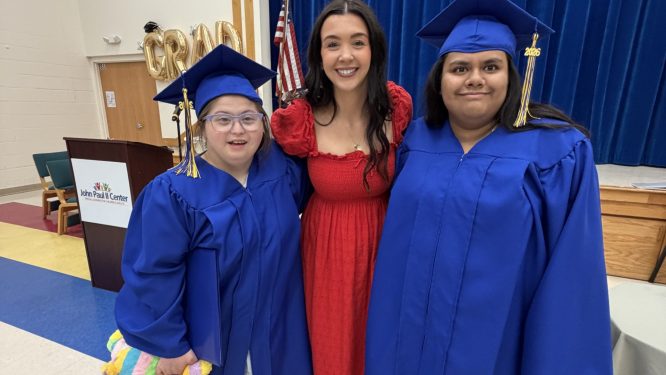
John Paul II Center for Special Learning Celebrates Graduation

Michael Schlicher Named 2026 Kutztown University Employee of the Year
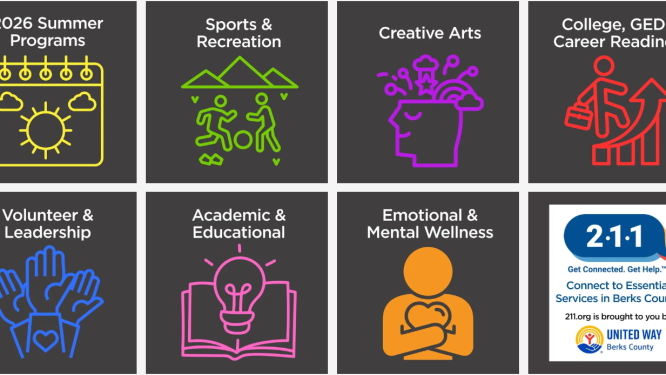
RDG Youth Hub Connects Reading Youth and Families to Opportunities Citywide