From Daniel Bobb Mill & Farmstead
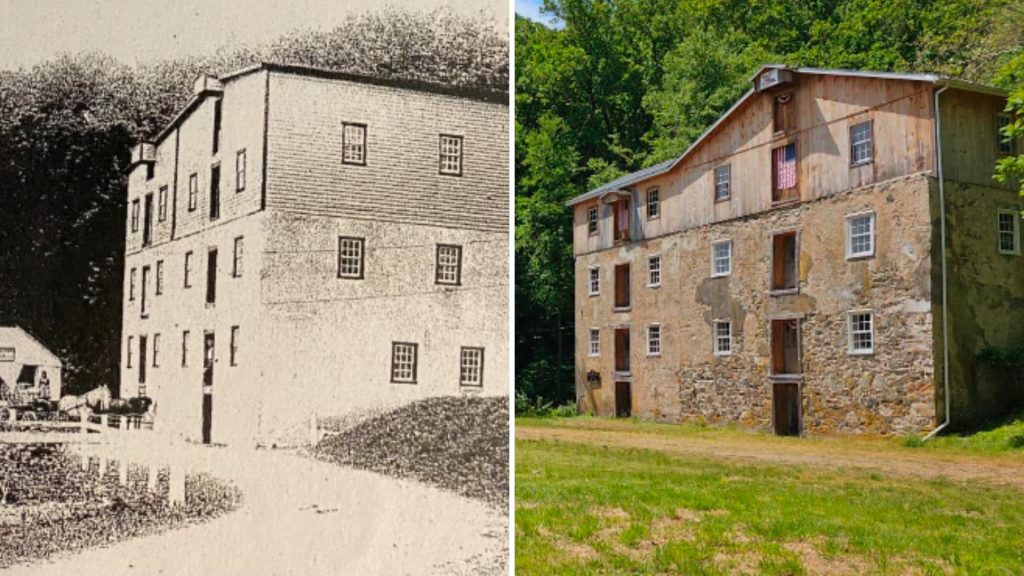
Pictured above, from left to right: A post-1870s photo and a modern photo of the Daniel Bobb Mill & Farmstead.
On Friday, Feb. 6, the National Park Service announced that the Daniel Bobb Mill & Farmstead joined the National Register of Historic Places, following years of research and conservation efforts to recognize its significant contribution to U.S. history.
Built under the reign of King George II, the Daniel Bobb Mill is now the oldest registered mill in Berks County. It is also among the top 10 oldest registered mills in Pennsylvania and one of the few in the U.S. preserving all the elements of colonial mills, including machinery, mill race, stonehouse, and sweitzer barn.
The Daniel Bobb Mill & Farmstead is a mill complex of early 18th-century architecture credited to German immigrants from Pfalz (modern state of Rhineland-Palatinate) who, escaping religious persecution, settled the region decades prior to the formation of our nation. The German settlements established a strong agricultural-industrial community that later supported troops during the Revolutionary War and the birth of the U.S.
The mill contributed to the success of the farming community for over two centuries and held a key role in establishing a strong German Mennonite and Lutheran community that prospers agriculturally and culturally today. The name of the property honors the legacy of one of the mill’s earliest owners, Daniel Bobb, who, according to a Muster List dated 1779, joined the Hereford Company (Fifth Class) under American Capt. David Strausse with the Revolutionary War Troops.
Mr. Bobb’s son, also named Daniel, fought in the 46th Pennsylvania Infantry Regiment in the Civil War, which played a relevant role in the Gettysburg battle and the Atlanta campaign.
Under its education and conservation project, the mill will eventually be opened to the public as a museum, along with a library and learning center specialized on PA Dutch culture. On Saturday, June 20, at 8:30 p.m., there will be a special 250th anniversary celebration of American independence.
Andres Coello, president of Roark Americana, said, “When I first entered the building in 2018, I was taken aback by its ability to transport us 300 years back in time, to a period when America was still a British colony. I believe the property’s historic significance lies precisely in that it reflects the struggles and hardships that defined the Pennsylvania pioneers, many of which came to America escaping from religious persecution. Having the property officially joining the NRHP honors multiple generations of German immigrants that turned the state into the powerhouse of the American Revolution, in a region that was also home to the first Catholic church outside of Philadelphia, highlighting the area’s rich cultural heritage and the values of hard work, tolerance, and cooperation that continue to be the foundation of the American Dream. I would like to thank historian Mary Sue Boyle for her invaluable historic research, which brought to light many fascinating facts hidden for almost three centuries.I would also like to recognize the work of the Pennsylvania Historical and Museum Commission, which supported the nomination from the very beginning. Specially, I would like to thank Jennifer Thornton and Elizabeth Rairigh, two outstanding PSHPO professionals to whom our state owes the preservation of invaluable treasures of art and history. We are proud of you! State Senator Tracy Pennycuick and Representative David Maloney, two public officials of impeccable credentials and authentic representatives of the people of Berks, encouraged us to pursue the nomination and have provided invaluable support to our Education project. We look forward to their presence at the 250th Anniversary celebration on June 20.”