by Nehal Trivedi
Nehal Trivedi, a sophomore at the Wyomissing Area High School, recently went on a volunteer trip to India, along with 26 high school students from around the country, with the program AIM for Seva to teach children English, math, and science at a charity school in a village. Here is Trivedi’s account of the experience.
Introduction
Meeting students from around the USA, forging bonds with 10-year-olds whom you never knew existed, and late-night walks to the nearby market to get snacks with your friends; that’s the allure of a volunteer trip abroad. I was fortunate enough to be able to go on the Global Youth Leadership Programme (GYLP) this past December, and I wanted to share my transformative experience of teaching underprivileged children in India with my community. I heard about this trip through AIM for Seva, an organization with chapters throughout the United States whose goal is to raise money to sponsor education in rural India. GYLP is a facet of this organization, where 26 high school students go to Manjakuddi, Tamil Nadu, during their winter break to teach 6th- 9th graders English, math, and science in a charity school sponsored by AIM for Seva. You get to walk around the village, visit the temples and do meditation every morning, talk to the college students at the local trade school, take care of the cows at the Goshala, eat the fresh-grown food at the Koodam, and so much more. As a volunteer, you learn so much. The two weeks I spent in India on this trip were some of the best days of my life.
Understanding the Context
While India is a country developing incredibly quickly, and is rising in the global economy, it has some of the worst economic disparity in the world. You can be driving along the highway and see tall skyscrapers and clean streets on one side and see a village of thatched roofs and broken plumbing systems on the other. While one of the most widely spoken languages in India is English, and while most of India is educated with a high school diploma, the children in these poorer villages usually go to a village school that doesn’t have the best programs or funding to give these children an equitable education. AIM for Seva believes in the importance of education from elementary school to college to break the cycle of poverty that often remains in these villages. With a better education, these kids can leave their small villages and pursue education in cities. According to the Gitnux 2024 market data report for India, nearly 5 million children do not attend school in India, and as of 2020, India had over 250,000 private unaided schools.
Preparing for the Journey
Ever since I was as little as nine years old, I had heard the stories from my friends’ siblings who’d gone on GYLP and couldn’t wait until I was old enough to apply for the opportunity. I applied to go on the trip in March of 2022 and heard that I had been accepted sometime in May. Over the summer, there would be monthly Zoom meetings preparing us for the trip, assigning us to our teaching partners, and countless hours spent over the phone with my teaching partner working on our lesson plans. As the school year started, and the India trip started coming closer, more physical preparations were made, from buying the multitude of kurtis needed for the trip to buying books to give to the kids. Before the trip, I was uncertain about how two whole weeks with barely any internet and only traditional South Indian food to eat would be like, but I soon realized I had nothing to worry about.
Arrival and Immersion
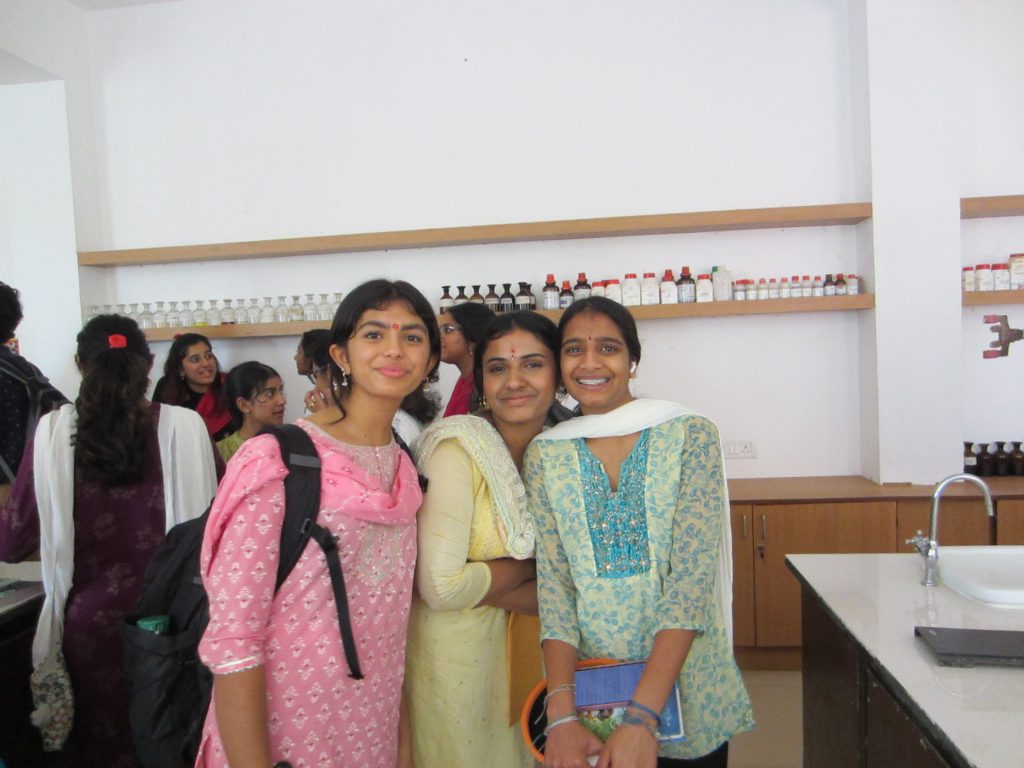
The journey to Manjakuddi was extremely tiring, but still incredibly enjoyable since I was with some of my best friends and met incredible people on the trip. First, all of the trip participants met each other at the airport, most of us meeting for the first time. Some of us had gone to India and Tamil Nadu many times, others had only gone to India once or twice in their lives, and for some, it was the first time they’d ever be immersed in India. We all took a 14-hour flight to Dubai, had a 6-hour layover there (it felt like an eternity), and then flew the remaining 4 hours to Chennai, Tamil Nadu. We stayed overnight at a Hilton hotel close to the Chennai airport, and then at nine the next morning set off on our 8-hour drive to Manjakuddi, where we’d be teaching. Manjakuddi is the village in India where the founder of AIM for Seva, Swami Dayananda Saraswati, was born. We lived in the Daya, a dormitory built for GYLP trip-goers, with the girls on the top floor and the boys on the bottom. Right next to the Daya was the Goshala, a local pasture owned by AIM for Seva, where cows were kept. We would wake up every morning and go to sleep every night, hearing their moos. Down the street was the Koodam, a cafeteria where we’d eat breakfast, lunch, and dinner, and a little farther was the meditation center and the temple for the goddess Lakshmi, where we’d go every morning to meditate and pray before going to breakfast, respectively. After breakfast, we’d take a bus to the school, driving past its adjoining college to teach our students. Manjakuddi is known to be one of the cleanest villages in all of Tamil Nadu, and it lived up to its name. I had never been to Manjakuddi, much less Tamil Nadu, and right when I stepped off the bus, I remember thinking it was a beautiful place. Even though it is the center of AIM for Seva’s movement in India, it is a village like any other, with people who live and work there.
Teaching and Learning
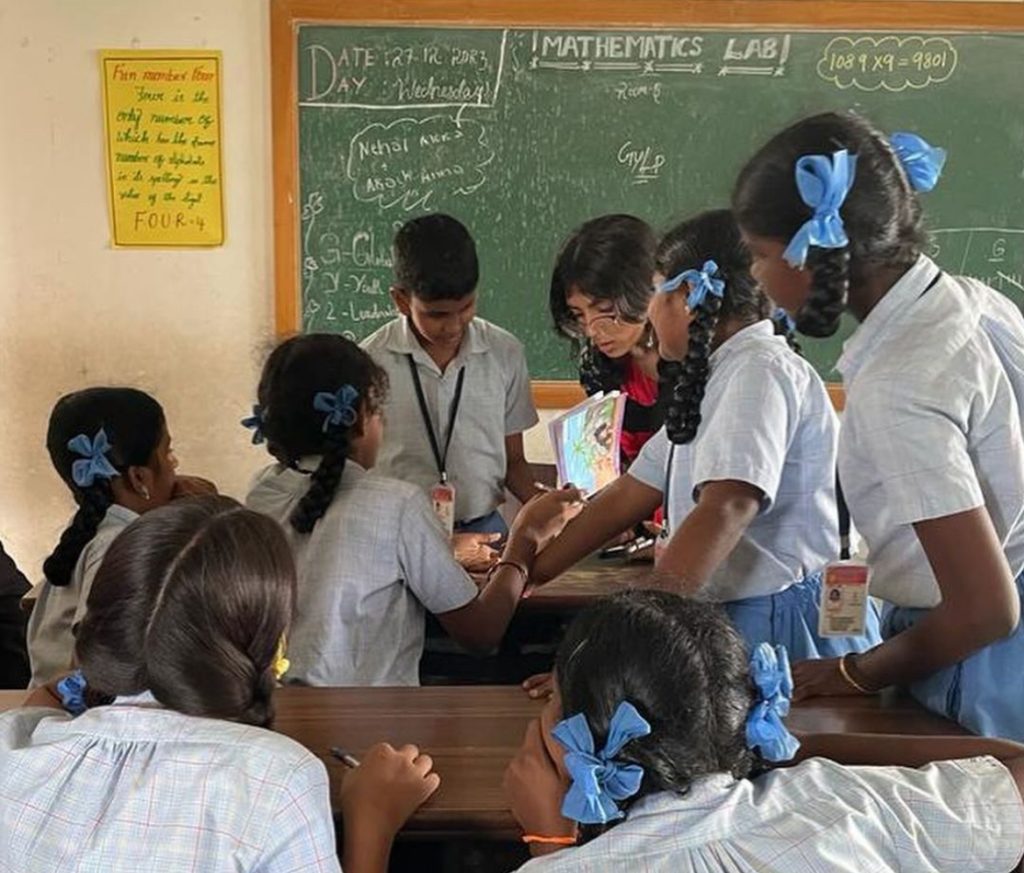
As a volunteer, our usual days had a pretty set schedule: we’d wake up around 6, get ready for the day, walk to the meditation center and then to the temple, go to the Koodam as a group for breakfast, take a walk back to the Daya to get whatever materials we needed for the day, and then take the bus to the school. We’d stay at the school till lunch, teaching English/public speaking for the first hour and a half and math for the second. We’d drive back to the Koodam for lunch, and then an hour later, were back on the bus for the 5-minute drive to the school. In the afternoon we’d teach them science and do various experiments for 90 minutes, and then it would be time for PE (physical education) for the kids. We’d go outside with them every day, playing a mix of tag, volleyball, frisbee, badminton, and whatever new games were invented for the next hour. After that, at around 3, the kids would get on the bus and go home, and we’d go back to the classrooms for a 30-minute Sanskrit class taught to us by one of the Manjakuddi teachers. After that, we’d drive back to the Daya just in time for teatime, and then we had the rest of the night to ourselves to do whatever we wanted. Dinner was around 7:30, and we’d have a group meeting to talk about the day at 9:30 every night with a curfew of 11. On some special days, we visited the rice fields, went to the local trade school, and on New Year’s Eve participated in a temple procession down the streets, and the next day drove two hours away to visit the Tanjore Big Temple.
Sometimes, it was hard teaching the kids; as I do not speak Tamil, so some of the kids in our class struggled to understand me and vice versa, but over the two weeks, we got closer, and it was easier to understand them. Over the next two weeks not only did I teach the kids many things, but I learned from them so much as well. They loved to give me lessons in Tamil, and I even visited a few of their houses! They would talk to me about life in the village, and I realized how much I had to be grateful for the things I’d always taken for granted. Some of these kids had so much less than me, yet were so incredibly happy and filled with so much love and laughter that they continue to inspire me.
Two very notable kids in my class who I don’t think I’ll ever be able to forget were 11-year-old Kanishka and 12-year-old Rithik. Kanishka is one of the smartest little girls I have ever met. Her English was perfect, she knew a fair amount of math, and she had an amazing talent for public speaking. In class, she’d always be the one with her hand raised high, and even when she wasn’t sure of the answer, she always wanted to try. She’d be the girl her older classmates would surround, trying to catch a glimpse of her answers. On our last day in Manjakuddi, there was an assembly with us and all of our kids. Each class had to choose one student to speak for two minutes about something they were passionate about during this assembly. Kanishka was the student my teaching partner and I chose for this. I remember her speaking about GYLP and how much she loved her student teachers. She spoke even better than I could have at eleven, in front of such a large group of people, without stumbling or muttering over a single word.
The other student that I’ll always remember is Rithik. Rithik was the opposite of Kanishka. Naughty, hated public speaking, couldn’t sit still. I remember he was one of my more difficult students at the beginning of the two weeks. His English was also not the strongest, so it was very hard for us to connect during a good chunk of the time I was teaching him. What stuck out to me about Rithik, though, was that while he wasn’t extraordinary in English, he was incredibly passionate about mathematics. He would raise his hand throughout the English lesson, asking when it was time for the math portion of the class, and when it came, he would all of a sudden become the model student: quiet, intensely focused on whatever question he was trying to conquer. While math was still as difficult to him as English he would not give up until he had found the answer to his problem. His delight and fascination with mathematics astounded me, and his passion for a topic that was still so difficult to him showed me the potential he had. By the end of the trip, Rithik became very dear to me, and when he handed me a chocolate bar and a pink bracelet with the words ‘best friend’ on it on the last day, I knew I meant just as much to him as he did to me.
Continued Support
Even though I loved my trip to India, and know my friends and I raised a lot of awareness for the kids there, we need more sustainable initiatives to support underprivileged children in India beyond these volunteer trips. Though they help, and the money raised is going directly to improving the livelihoods of these kids, there needs to be more direct action taken to help not only them but underprivileged children all around the world. Think of all the potential talent that will remain hidden without allowing children everywhere to have an equitable education. Movements like Every Child Educated and Pehchaan The Street School are doing all they can to help underprivileged kids around the world and India, but we can do so much more if more people join this cause. Charity and community organizations need to work together to come up with innovative ideas to help this situation. Even you can help the cause, whether by working with your local organizations to provide education enrichment opportunities, or even using social media to launch awareness campaigns. Additionally, a lot of the students we taught who lived in the Chatralayas, the charity homes, of sorts, barely ever got to see their parents, and were only able to call them once a week, sometimes less, since they were far away working to earn money. A possible initiative could be to create an organization that provides local business opportunities in the villages themselves.
Acknowledgments
Overall, GYLP was a life-changing trip, and I would like to thank AIM for Seva, Swami Dayananda Saraswati, Srini Uncle, and all the others who made my trip possible and allowed it to be as amazing as it was.
You Might Also Like
Junior League of Reading Hosts “Nurturing Equity” Panel Discussion
Dr. Carl Sheperis Receives Distinguished Professional Service Award from American Counseling Association
NHS Lending Programs (English) | More than a Home